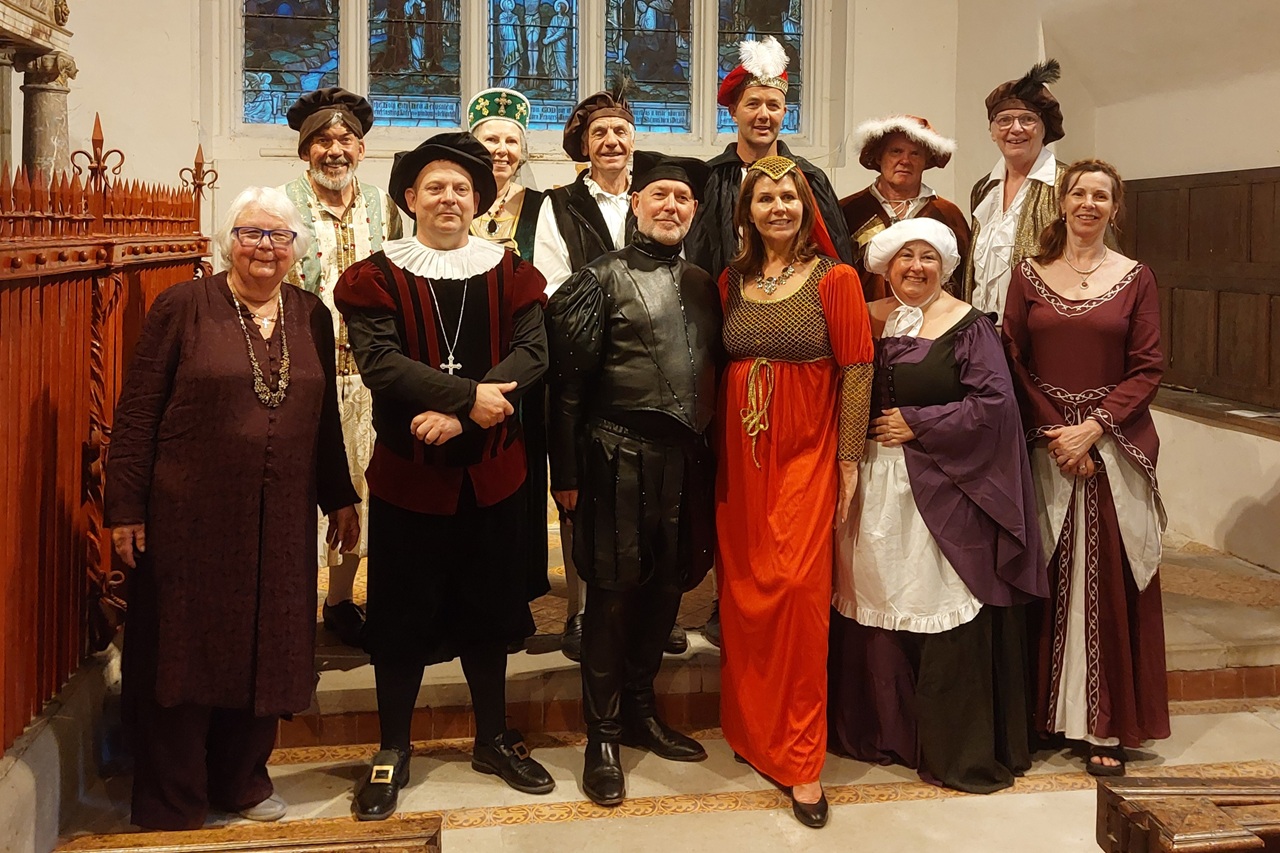
You’re probably aware that Hunsdon Church has an extraordinary history because of its association with the Tudor Royal Family. I was once in a conversation with other members of the diocesan clergy in which one was celebrating their church’s heritage pedigree and saying, “I bet nobody can top that!” I just said, “Henry VIII, Edward VI, Mary I and Elizabeth I would almost certainly have worshipped in my church.” Dumbfounded, my colleague granted that St Dunstan’s had a better claim to the “top spot” than hers. I hadn’t even mentioned Edward IV or Charles II who were both here as young children. Or the various queens that Henry VIII would have brought with him!
But the walls have observed the lives of other people too, and our “Opening the Archives” event spent a little while thinking about a few of those people. The first was Nicholas Ridley, Bishop of London in the Tudor Period who was ultimately executed by Mary I on 16th October 1555. He lived in Much Hadham, and one day, called to see Mary while she was living in Hunsdon House. It is a famous conversation that included her offer that he could preach in “the parish church adjoining” (i.e. Hunsdon Church). It is famous because it was recorded in Foxe’s Book of Martyrs and seems to mark the moment when the relationship between the Bishop and the Queen finally went sour.
We considered also the Revd Philip Elliot, Rector of St Dunstan’s during the third quarter of the 17th century. There’s a mysterious moment in his clerical career where he simply ceased to be the Rector for a few years only to be reinstated later. Some have suggested his break in service related to his not holding the same beliefs as the Church of England. Others have suggested it may have been related to his politics (he was a staunch supporter of the Commonwealth). It is likely that those overlap significantly! We know he was fiercely opposed by local Quakers and that more than once, he found himself before the court in connection with a property called the Dog House. I had heard it said he was related to Widford Church’s famous son, John Eliot, but had never known what that relationship was. In my research, I was pleased to find evidence of the connection.
We heard about another Hunsdon family who emigrated to the New World in the 17th century and a racing driver who went there from Hunsdon in the 20th century. Attendees were then able to look around the building and to share some of the stories they knew about their families and their longstanding connection to the community. There are lots more stories out there, and we’re keen to write up what we know to build up a rich and interesting history for all to read. Do keep an eye on the church’s history website – history.hunsdonchurch.org – and bring your own stories to the next event.
Mark Dunstan